https://us12.campaign-archive.com/?u=1d2d0b12657855f58481cffa4&id=f145798623
 |
| Hello! |
| As we reach the end of the year, I’ve been thinking about the journey we’ve travelled together in 2025. It has been a year of change, challenge, and real progress for Tackle, and, as ever, it’s your work in your communities that gives everything we do at the centre its purpose and strength. Last week’s Support Group Leaders’ meeting was a reminder of that. Hearing from John from the Dodgy Walnut and Mark from Stafford about the impact they’re having locally was genuinely uplifting. Their stories echoed what we know to be true across our 150 groups: that peer support saves emotional lives, strengthens coping, and helps people living with and affected by prostate cancer navigate some of the most difficult moments of their lives with dignity, knowledge, and community. You’ve continued to show, month after month, what happens when people come together with compassion, determination, and lived experience at the heart. As a small and mighty central team, we draw our energy, our direction, and our courage from your work. Thank you, sincerely, for everything you give. As we look ahead to 2026, there is much to build on, much to learn from, and much to shape together. We’re proud to be walking this path with you. Our central office function will be closed from 19th December until January 5th as our team takes a well-earned break. We look forward to seeing you at our next Support Group Leaders meeting on Tuesday, January 6th.In the meantime, we are here to answer your queries and receive comments on our work, so please do get in touch. Before I close, I also want to thank so many of you who have quietly checked in on Bruce over the past six months. After 21 weeks of intensive chemotherapy, his latest scan shows no sign of active cancer, which is remarkable. His recovery will be slow, but we are looking forward with hope, and, all being well, he plans to join us at the conference in Birmingham in March. This year has taught me more than I ever imagined about what it means to live alongside cancer, and even in the hardest moments, it has shown me the extraordinary power of support and of this community. Wishing you all a peaceful and very happy Christmas. Sarah, and all the team at Tackle Central |
| UK National Screening Committee Decision |
| Many of you have shared your deep disappointment at the recent recommendation from the UK National Screening Committee not to introduce a population-wide screening programme for prostate cancer at this time. We understand how much hope, energy, and lived experience underpin the desire for change, and how strongly you and your group members feel about preventing late diagnosis. We share the deep disappointment and feel this too. As ever, we will continue to operate from a position of evidence, integrity and partnership, and we want to set out clearly the practical next steps we can take together. First, your voices remain vital. We are asking all support group leaders to continue gathering lived experience from your communities, particularly stories linked to family history, delays in accessing PSA testing, conflicting advice from GPs, or barriers faced by people who received a high PSA reading at a community event. If someone says, “This happened to my neighbour,” please encourage them to write it down. These real-life accounts strengthen our influencing work and will help shape sector-wide conversations as we look ahead to future campaigns. We anticipate that our consultation response will form part of a coordinated approach with partners, and we are already meeting with a number of stakeholders to understand what that might look like. We will update you as soon as there is clarity on the process. We also want to address a point of confusion. Some have interpreted the NSC decision as implying that the PSA blood test itself causes harm. That is not what the NSC has said. Their concern is not about the safety of a PSA blood test, but about its reliability as a population-level screening tool. In January, we will provide clear messaging for you to use in your local community awareness work so that this distinction is fully understood. Please continue to encourage participation in the TRANSFORM trial. If anyone in your networks, family, neighbours, or colleagues receives an invitation, taking part will help build a stronger evidence base currently missing and essential for informing future decisions about risk-based screening. Finally, David James (PCR) will join our January Support Group Leaders’ Meeting to share early insights from an independent group examining the NSC evidence. This will help us all understand where the uncertainties lie and what any consultation response may involve. Thank you for your leadership and steadiness at a time when emotions are understandably high. We will keep you informed every step of the way. |
| Our Annual Conference – Save the Date!Registration will open mid January 2026. |
 |
| Hot Topics |
 This month’s Hot Topics is well worth a read and sharing with your group members. It includes:The launch of the national TRANSFORM trial, with the first 16,000 men now receiving invitations, is an important development in targeted prostate cancer screening research A clear summary of the National Screening Committee’s draft recommendation, setting out why they have proposed screening only for people with specific BRCA variants and not for the wider populationA powerful Guardian feature which highlights the real experiences of people living with prostate cancer, including some of our own support group leaders, and a piece highlighting our Peer Coaching/Make Sense of It pilot.Please do take a moment to open the Hot Topics and pass it on; it’s a really valuable way of keeping your group members informed with accurate, up-to-date information. This month’s Hot Topics is well worth a read and sharing with your group members. It includes:The launch of the national TRANSFORM trial, with the first 16,000 men now receiving invitations, is an important development in targeted prostate cancer screening research A clear summary of the National Screening Committee’s draft recommendation, setting out why they have proposed screening only for people with specific BRCA variants and not for the wider populationA powerful Guardian feature which highlights the real experiences of people living with prostate cancer, including some of our own support group leaders, and a piece highlighting our Peer Coaching/Make Sense of It pilot.Please do take a moment to open the Hot Topics and pass it on; it’s a really valuable way of keeping your group members informed with accurate, up-to-date information. |
| Website Changes |
 We’ve recently made some long-awaited updates to the Tackle website, the first significant refresh since 2021, to give it a cleaner, more accessible, and easier-to-navigate feel. We’ve recently made some long-awaited updates to the Tackle website, the first significant refresh since 2021, to give it a cleaner, more accessible, and easier-to-navigate feel.We hope you’ll notice the changes and see how we’ve worked hard to make the site clearer for people looking for support, information and guidance. A huge thank you to Molly, who has led this work with enormous care, and to Out of Place, our design and web team, for bringing the improvements to life. As a small organisation without the resources for large-scale user testing, we’re turning to our wonderful community of support group leaders for your help: if you spot any broken links, grammatical errors, or anything that doesn’t quite work as expected, please do let us know so we can put it right. Your feedback will help us keep the site as usable and welcoming as possible. |

| We’re inviting all Tackle group leaders and organisers to join the next session in our Equality, Diversity and Inclusion series, co-delivered with Prostate Cancer UK. This practical, friendly workshop will deep-dive into facilitation skills, tips, and techniques for effectively leading groups in an inclusive and equitable way. It will be both knowledge- and skills-based, offering participants the opportunity to practice techniques with one another during breakout sessions. It will cover the following topics:Emotional intelligenceActive listeningBoundariesBuilding relationships and rapportManaging group dynamicsPublic speaking/presentation skills |
| January Support Group Leaders Meeting |
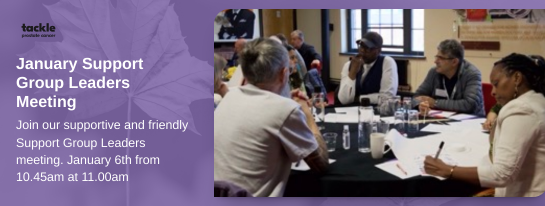
| At our first meeting of 2026, we will answer your questions about the NSC decision and discuss new opportunities for 2026. |
| Men’s Health Strategy |
| The UK Men’s Health Strategy, published in November, gives our community a major opportunity to shape how support for men, and all people living with and affected by prostate cancer, is delivered in the years ahead.The Strategy recognises the deep inequalities men face in diagnosis, outcomes, and access to care, and places real emphasis on community-based approaches, lived experience, and culturally competent support. This speaks directly to the heart of what our local groups do every day. It highlights the value of trusted spaces where people can talk, learn, and make sense of their treatment options, and the importance of reaching historically underserved communities.For support group leaders, this is also a moment to ensure your experience shapes what comes next. While we must be realistic about the limited capacity smaller charities have to influence national action plans, the Strategy does create openings for us to bring the voices of our community into the conversation, particularly around peer support, informed choice, and the realities of treatment decision-making.Your insights from the groups you run are vital in helping us understand what men and their families need on the ground. As opportunities arise over the coming months for learning and shared dialogue, we will keep you informed. |
| New Resources on the Members Portal |
| We’ve added two new resources to the Support Group Leaders’ Portal to help you strengthen, sustain and grow your groups.Guidance for Developing and Facilitating Prostate Cancer Support Groups offers practical ideas on leadership, shared responsibility, engaging new members, and avoiding burnout.Roadmap for New Groups provides a straightforward, step-by-step guide for anyone starting or reshaping a group in their area.These documents have been co-developed with a number of Support Group Leaders, and we are very grateful for this input. We encourage you to take a look, and while you’re there, explore the many other documents on the Members’ Portal designed to help you run welcoming, sustainable, and confident support groups across your communities. These two new guides offer fresh ideas on structure, leadership, outreach, and sustainability, helpful whether your group is long-established or just getting started. The Roadmap is especially useful for newer groups or those undergoing transition, giving clear, practical steps from first conversations to ongoing growth. The Guidance document includes real examples shared by fellow group leaders, along with advice on involving partners and working-age people, and on supporting those recently diagnosed. Don’t forget the wider Members’ Portal, it’s full of templates, governance resources, template constitutions, safeguarding guidance, and practical tools that can make your role easier day-to-day. If you spot anything missing or have suggestions for future resources, we’d love to hear from you. |